 XinYue Kinë
In modern industrial manufacturing, coatings do not merely add color to products; they also serve as the first line of defense against environmental corrosion and service life degradation. As global environmental regulations grow increasingly stringent, powder coating—a coating technology that generates almost no solvent-based VOC emissions—is gradually replacing traditional liquid paints.
Yet even among powder coatings themselves, some are only suitable for indoor use, while others can maintain color stability outdoors for up to 20 vjet. Where exactly does this massive performance gap come from? This article will further elaborate on the importance of powder coatings, and conduct an in-depth analysis of various organic polymer powders that act as its core film-forming substances.
1、The Advantages of Powder Coatings
Powder coating is a solvent-free coating that exists in a solid powder state. In the spraying process, free-flowing, dry, thermosetting or thermoplastic powder materials are applied to the surface of parts, and it is suitable for metal substrates as well as some temperature-resistant engineering plastic substrates.
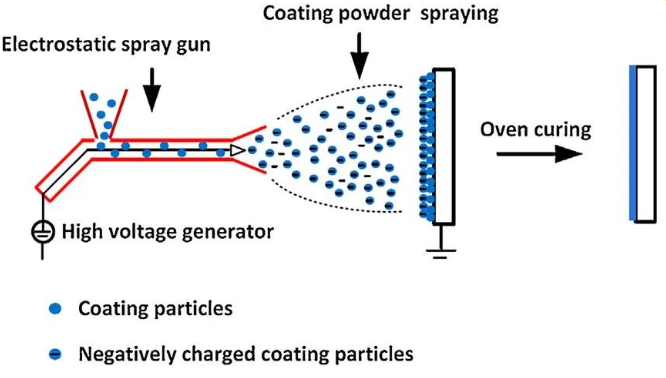
Compared with traditional liquid coatings, its advantages are reflected in the following aspects:
- Environmental friendliness
Traditional paints release large amounts of volatile organic solvents during application and drying. These emissions are not only a major source of air pollution but also pose serious health risks to workers. Since powder coatings contain no solvent system, virtually no VOC emissions are generated during construction. - High material utilization
In the spraying of liquid coatings, overspray is mostly wasted. By contrast, unused overspray powder can be recovered through a recycling system, sieved, and reused. The material utilization rate of powder coatings can generally reach more than 95%. - Excellent performance
In most industrial applications, powder coatings provide higher density and better chemical resistance than traditional solvent-based liquid coatings. They can form thick film layers in a single application, typically ranging from 60 to 120 micrometers or even thicker. - High production efficiency
Although powder coating curing requires high temperature, the overall coating process is simplified — no pre-evaporation or repeated spraying is needed. This greatly improves production efficiency and reduces comprehensive energy consumption and labor costs.
2、Core Film-Forming Substance: Organic Polymer Powder
The performance differences of powder coatings essentially stem from the organic polymer powders (resins) adopted. In actual formulation design, powder coatings are not a simple stack of single components. They generally take one or two types of polymer powders as the core base materials, supplemented by curing agents, pigments and additives, and are precisely formulated according to application requirements.
It is worth noting that the resin determines the performance ceiling of the coating — including weather resistance, anti-corrosion grade, mechanical strength and cost range. The selection of different resin systems is essentially an engineering trade-off.
In summary, the rise of powder coatings is the result of the combined effect of organic polymer science and environmental protection concepts. To make good use of powder coatings, it is essential to understand the functions and limitations of the above organic powders, so that formulas can be better adjusted to achieve optimal coating performance.

WhatsApp
Skanoni kodin QR për të filluar një bisedë WhatsApp me ne.